Beyond the Treeline: Chasing the Barrens Big Five.
Raw and breath-taking, the sweeping landscape of the Canadian barrenlands is difficult to put into words, let along photograph to scale, it’s visually impressive and the wildlife that call this area home are majestic. While the “Big Five” was a term popularized by the African Safari, Canada’s North has its own equally impressive list.
Below is an overview of the barrenlands “Big Five”: Barrenground Caribou, Grizzly Bear, Wolf, Moose and Muskox. There are of course smaller creatures, and we’d be remiss to leave out the ghost of the barrens, the elusive Wolverine, so have include this animal as a bonus.
To dive deeper into the behaviour and habitat for each species follow the links at the end of each section and, be sure to check out our wildlife photography tips.
Location, location, location – three critical factors of success.
Success to seeing these animals in this vast canvas is knowing where to be and when. This is where the location of Peterson’s Point Lake Lodge is your greatest asset. Situated on the southwest shore of Point Lake, this area is known for caribou migrations, and its body of water stretches over 70 miles long. The east to west orientation allows us to access a large range of territory by boat and on foot to look for wildlife.
1. BARRENGROUND CARIBOU
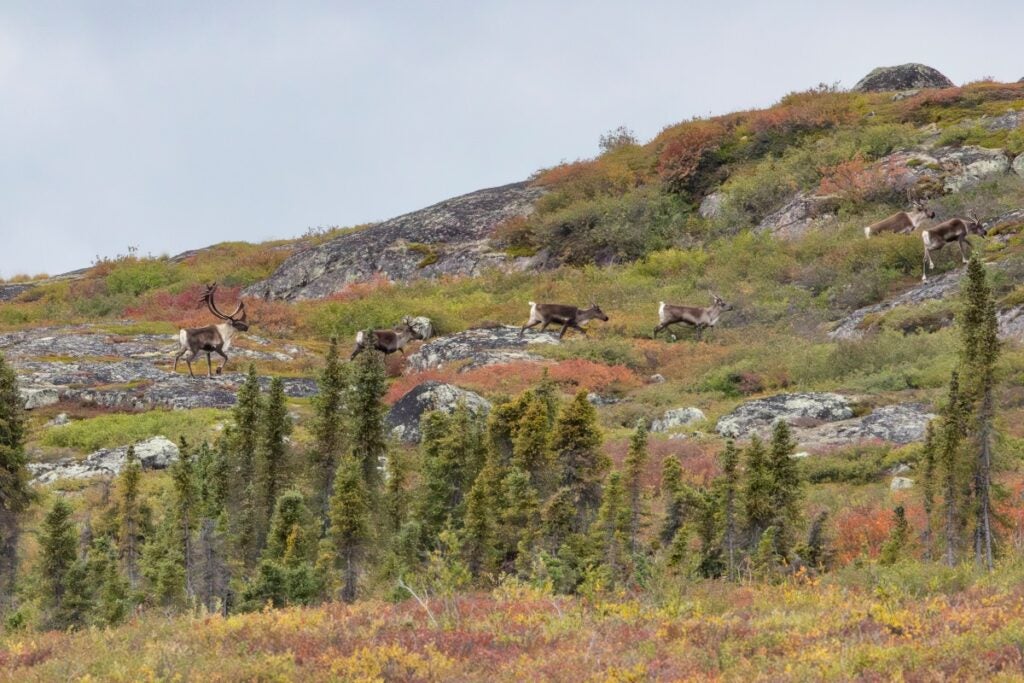
“Caribou bring life to the land!” It’s a refrain often repeated by Indigenous elders, who for generations have depended on the caribou for their very survival. And, although we do not make any guarantees about caribou sightings, we are pretty darn confident you will see caribou, and likely some magnificent bull caribou at that, during your stay at the lodge, notably for those who visit later in the season.
Caribou Range & Herds
The barrenground caribou (Rangifer tarandus groenlandicus) ranges from Alaska to Greenland, and from the arctic coast to northern Saskatchewan, Alberta, and Manitoba, and a bit into Ontario’s Hudson Bay coast. There are 11 – 14 sub-populations, often called “herds”.
Caribou travel great distances, many spend the winter in the boreal forest or treeline. They migrate north in the springtime to calve near the coast on the open tundra before beginning their southern migration, travelling via ancestral routes through the barrenlands for the summer.
Point Lake is a known traditional area where caribou follow time-honoured migration routes; their paths are deeply entrenched in the landscape and provide good hiking trails. Three caribou herds are known to travel through the area, the Bluenose East, Bathurst and Ahiak.
Caribou Sightings
So, at Point Lake, where can you see caribou? Well, possibly from your cabin porch or from the Lodge! In early morning, look around the lodge grounds and then sweep the nearby hills with your binoculars. There are often several large bulls that can be seen near the Lodge, grazing and sleeping in the dwarf birches and spruces (there are likely fewer hunting wolves in the area near the lodge).
While travelling in the boats or while hiking anywhere, but especially along Esker Bay and Caribou Bay, you may see varying numbers of caribou. Both numbers of caribou and composition (bulls, cows and calves) can change annually and vary over the season as factors such as weather and insects can influence when they migrate though Point Lake.
Read the full Caribou article [here]
2. BARRENGROUND GRIZZLY BEAR
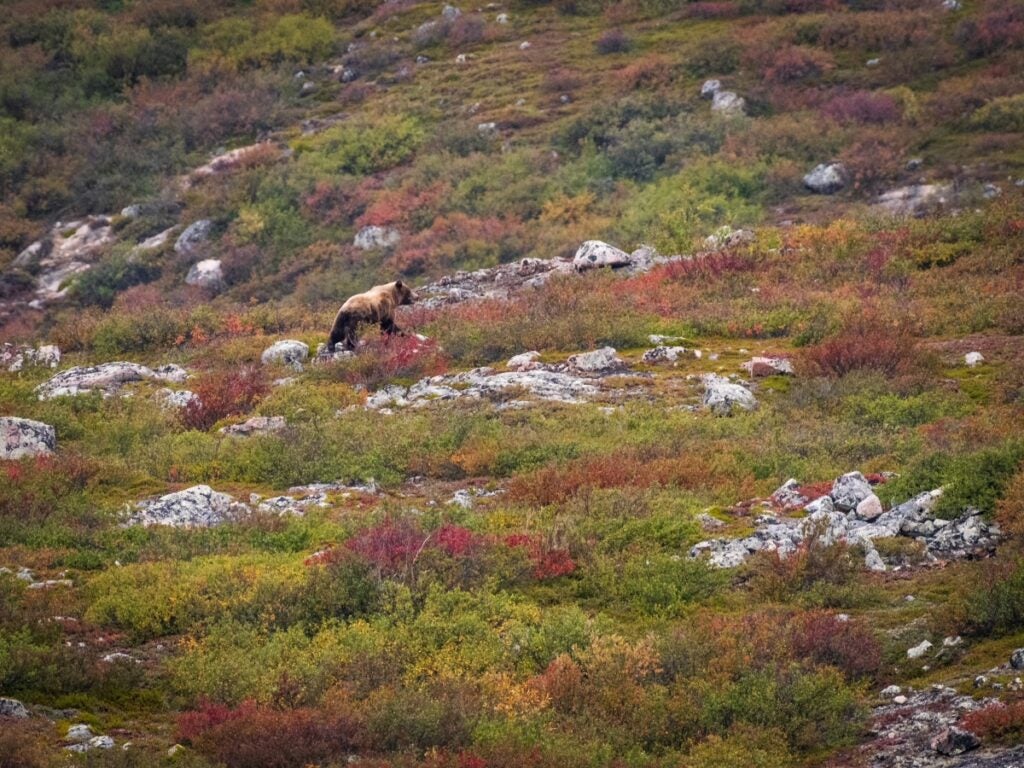
The barrenground grizzly (Ursus arctos) is our largest local predator, and they live a nomadic life, constantly wandering in search of food. They are omnivores, eating both plant and animal matter, and living at the edge of starvation at times.
Opportunistic Feeders
Early June is an important time for bears as they try hard to access the caribou herds to prey on new calves and placentas, or on the carcasses of caribou killed by wolves. They move on from this diet to feeding on emerging sedges, and then to roots and berries, arctic ground squirrels, voles, lemmings, birds and bird eggs/nestlings, anything they can cram into their mouths.
In the barrenlands, we simply don’t have the plentiful salmon runs as on the Pacific coast, so our grizzlies are not as large, nor as well fed. Because they are opportunistic feeders, grizzlies can become real pests around camps, especially if garbage isn’t handled correctly.
Different Colours
The colours of grizzlies vary considerably from dark brown to blonde, and some are mixed – their upper parts become very sun-bleached, while their legs remain dark brown.
A bear sighting is forever remembered and is often on a photography workshop wildlife photo shot list.
Safe Observation
So, where to expect you might see a bear at Point Lake? Sauntering down the beach in front of the lodge, along the shores, but also patrolling the ridges, and sometimes foraging along small streams entering the lake.
Lodge guides will constantly be watching for bears, as well as looking for evidence of them, both for safety and so that you may have the opportunity to see this magnificent member of our wildlife community. You can help by glassing the shores and slopes and also being on the lookout around the lodge and in the field.
Read the full Barrenground Grizzly Bear article [here]
3. MOOSE – Why this Forest Giant is Moving into the Tundra
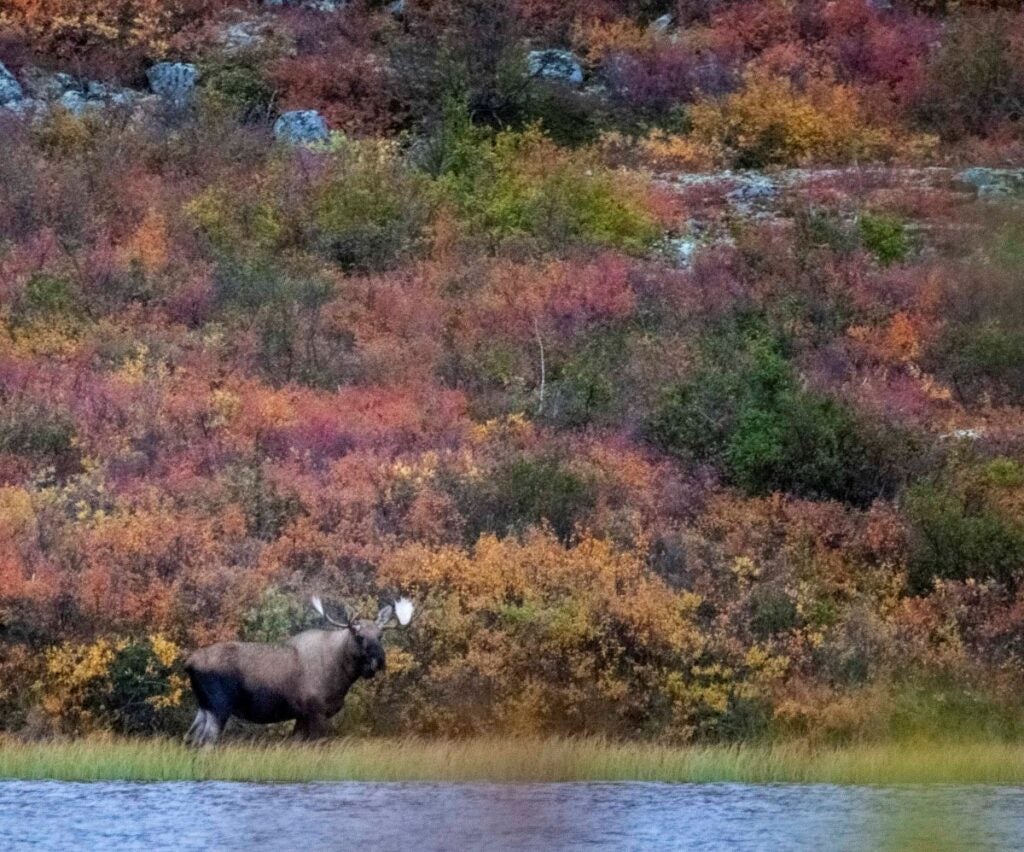
Moose (Alces alces) are mammals usually associated with the boreal forest. They crossed from Siberia to North America via Beringia some 15,000 years ago, and now occur over most of Canada, and down into the US in the Rockies, northern Minnesota and New England. Their range used to stop at the treeline but, due to the advancing growth of shrubs, they are commonly seen right up to the arctic coast. They can be invasive; historically moose did not occur on the island of Newfoundland but 16 animals were released there in the early 1900s, and they now are common.
Sightings of moose were rare in the treeline and tundra until about 15 years ago, but in recent years their numbers have increased significantly, likely in part due to increasing growth of shrubs, especially willows and dwarf birch. Most often moose are solitary; we see them at Point Lake annually, most often in brush, in small lakes like the one behind the guest cabins, in stream valleys or on the sides of the eskers. Look for a tall, dark shape, which may be mostly hidden in the spruce groves or feeding on willows.
Read the full Moose article [here]
4. WOLF
Creatures of infinite grace, wolves are supremely cautious. They are most active in low light but with 24 hours of daylight in the summer in the barrenlands, they need to be about their business during the day. We occasionally see wolves over the season, more so in the late summer and fall; sometimes they are near the lodge, other times they are seen on a hike or while travelling in the boats on daily excursions.
There is enough caribou activity around Peterson’s Point Lake Lodge to bring wolves into the area and there are a few known wolf denning sites which you may have the opportunity to check out during your visit, though they may not be used every year.
Types of wolves
So, what wolf could you see here? It would likely be the grey wolf (Canis lupis). Grey wolves occur in a variety of colour patterns, from brownish grey to whitish with grey mixed in, to black, or even all white, and we’ve seen all of these colour patterns around Point Lake.
Relationship between wolves & caribou
The wolves in the Point Lake area depend mostly on caribou, but will also take smaller mammals (arctic hares, ground squirrels, voles and lemmings) plus birds, especially ones they can surprise on a nest, as well as bird eggs. They will forage fish scraps, but don’t directly prey on fish. Wolves tend to follow the caribou herds, but in the Central Barrenlands, usually stop following the herds when the alpha female of the pack needs to den up to bear her young. Other wolves in the pack may continue to follow the herd, but some remain near the denning female. Caribou generally start to pass through the Point Lake area in July with more significant numbers starting mid-late August, so wolf pups can more easily be fed at that time. Once they’re able to follow the adults, life becomes easier for all.
So, when at Point Lake, scan the area early in the morning for local wolves, and scan the shoreline as you are boating or fishing. It will take sharp eyes indeed to see these clever carnivores, but the sight of these apex predators is mind-blowing.
And, if you don’t see a wolf, look carefully for signs, tracks on the beach in front of the lodge and scats (wolf poop) commonly found around old dens. Wolves ingest a lot of hair with their food, and it reappears in their scats – hare bones and hair, caribou hair, and even muskox hair.
Read the full wolf article [here].
5. MUSKOXEN: MUSKOX
No, it’s not Elon…..!
The Pleistocene Survivor
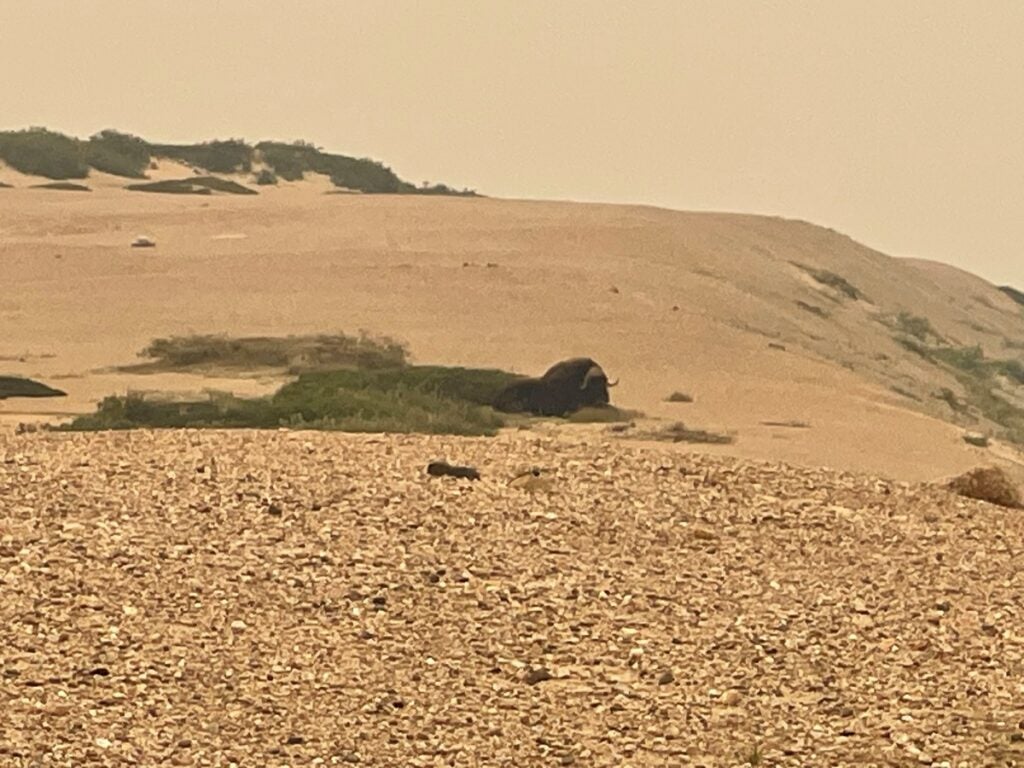
Muskoxen (Ovibos moschatus, called umingmak in Inuktitut, which means “the bearded one”) are remnants of the Pleistocene megafauna that occurred in many areas across the northern hemisphere during the Ice Ages, and included mammoths, mastodons, sabre-toothed cats, short-faced bears, giant sloths, ancient horses, and more. Most of these are extinct now, but the muskox remains, a lens into times past. They occur from Alaska’s North Slope right across both the Low and High Arctic to Hudson Bay and Greenland, and even south of Great Slave Lake to the Saskatchewan border. They live in scattered herds, and do not migrate geographically, though they may move into more protected valleys in winter. Once hunted almost to extinction to feed whaling crews, they rebounded during the 20th century, but appear now to again be losing ground, in many cases probably due to climate change.
A Chance Encounter
Muskoxen are not common at Point Lake; there have been a few sightings over the years from larger herds to solitary bulls. Chad had a close encounter with a huge bull that was bedded down by the creek near the lodge on a hot summer day. They wander the taiga and tundra, are bulky, dark, may be with buddies/family, and are easy to spot if they are in the area.
Read the full Muskox article [here].
BONUS: WOLVERINE
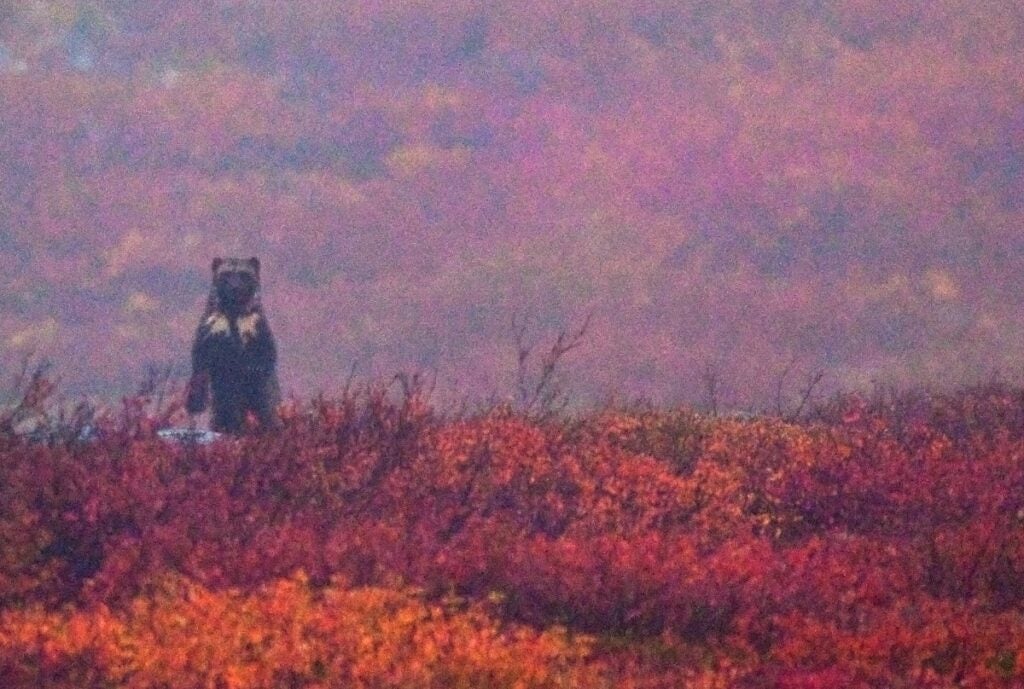
We’re sitting down on the tundra, glassing for animals, the weather is overcast and misty, and motion draws our eyes. It’s a dark animal, about the size of a Staffordshire terrier but stockier, with a light line along the side, huge feet and a tail. It stands up like a mini-bear, and we were able to get this photo, before it whirled around and galloped into a fringe of willows and birch, vanishing in seconds.
This is one of North America’s iconic northern mammals, the wolverine. If you see a wolverine at Point Lake, you are incredibly fortunate! Wolverines are one of the most iconic northern wildlife and on the wish list of most people who visit the treeline or tundra. But they are wary and shy. We know they are present around Point Lake, actually seeing a wolverine is very much a product of luck (and sharply watching at all times). They can be anywhere but are likely most easily seen along the beaches or on an esker. Watching in complete silence and staying motionless will give you the best chances.
The Tundra Cleanup Crew
Wolverines (scientific name Gulo gulo) are members of the Mustelidae or weasel family but are burly and robust rather than sleek and agile. Maligned and admired through history, they fill an important niche in the arctic ecosystem, like the niche of the hyaena in Africa. These are the “cleanup” crews of the tundra, taiga, and boreal forest. Wolverines have broad heads with heavily-muscled jaws and sturdy long curved claws. They can dismember a caribou or muskox carcass in short order, cracking even the leg bones and skulls of caribou to extract the goodies inside. Their teeth are formidable indeed, with sturdy canine teeth, and the upper molars are rotated 90 degrees inward, increasing the pressure that can be applied to whatever they are consuming!
And they eat literally anything. Working mostly by scent, they are able to scent and dig out hibernating animals. Adept hunters, they prey on nesting birds and their eggs, lemmings and voles, ground squirrels, tree squirrels, hares, insects, and amphibians. They scavenge large mammal carcasses, and placentas of caribou, moose, or other large mammals. They are one of the few predators that can handle a porcupine. They also eat small amounts of vegetation and berries. Wolverines resemble small bears, but have medium length tails. They are definitely NOT bears, but clearly weasel-like, active year-round, with a high metabolism. Wolverines have a bearlike gait, with “semi-plantigrade digitation”, front feet hitting the ground like a bear, and hind feet more on their toes.
Read the full wolverine article [here].